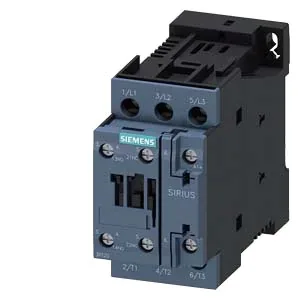
Mounting and clearances — fits the standard rail, but watch the breathing room
The S0 frame is 45 mm wide, 85 mm high, 107 mm deep. Mounting position: ±180° rotation on vertical surface, ±22.5° tilt forward/backward.
Switching capacity — where it earns its keep
This contactor's switching capacity is given per rated voltage, not a single blanket amp rating. At 24 V it switches 10 A; at 48 V and 60 V it handles 2 A; at 110 V it's rated 1 A; at 125 V it drops to 0.9 A; at 220 V it's 0.3 A; and at 400 V it manages 3 A. For motor loads at 230 V, it's rated 1 hp. The mechanical life is 10 million operations typical, with maximum switching rates of 1 000 cycles per hour for AC-1, AC-2, AC-3, and AC-3e duty, dropping to 300 cycles per hour for AC-4. The arcing time sits at 10 to 10 ms, and the DC operating time is 15 to 18 ms. These numbers tell you it's a general-purpose machine-tool contactor, not a high-speed chopper — fine for conveyor starters, pump runs, and crusher auxiliaries that don't cycle faster than every few seconds.
Environmental range — built for the cabinet, not the pit floor
That's standard for a panel-mount contactor — it shrugs off the heat inside a closed cabinet but isn't sealed for washdown or dust-ignition environments. The pick-up voltage is 0.8 of rated value; the drop-out voltage is 1.1 of rated value. So at 42 V nominal, it picks up around 33.6 V and drops out around 46.2 V — that's a tight hysteresis band, meaning it won't chatter on a sagging line, but it also won't hold in on a weak control transformer.