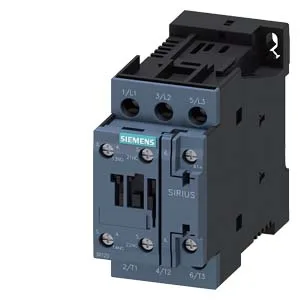
The 24 VDC coil (rated value 220 V, initial value 0.8, full-scale value 1.1) pulls in with screw-type terminals for the magnet coil — no spring-cage here, so expect a screwdriver for termination. Mounting is flexible: screw and snap-on onto 35 mm DIN rail per DIN EN 60715, with the mounting position allowing ±180° rotation on a vertical surface and ±22.5° tilt forward/backward. That means it fits tight enclosures where the rail isn't perfectly level or you need to angle the contactor for wire access.
Wire range accepts solid 1–10 mm² and stranded 1–10 mm², plus 2x (0.5–1.5 mm²) or 2x (0.75–2.5 mm²) for auxiliary contacts. The main contact wire range is 16–8 AWG — heavy enough for motor feeders up to the Size S0 rating. That -25 °C lower bound means it's fine for unheated plant areas in moderate climates; if your panel sits in a freezer or northern outdoor cabinet, check the ambient against the -25 °C floor.
Switching performance and mechanical life
Rated for 1 000 1/h at AC-1, AC-2, AC-3, and AC-3e maximum, dropping to 300 1/h at AC-4. That AC-4 rate (plugging/inching duty) is the limiting factor — if your application requires frequent reversing or jogging, the 300 cycles/hour cap governs the duty cycle, not the AC-3 figure. Mechanical life is typical 10 000 000 operations. Arcing time is 10–10 ms (essentially fixed at 10 ms). DC coil dropout time is 15–18 ms — fast enough for most safety circuits, but if you need <10 ms dropout for a safety-rated stop, consider a forced-guided contactor.
No rewiring or panel modification needed if you're replacing an existing S0 contactor with the same coil voltage.