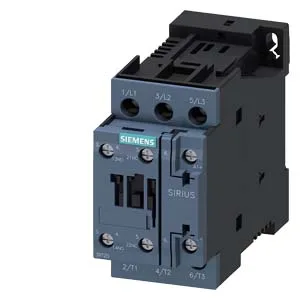
The 3RT2023-1NP30: The coil is rated for 200-280 V AC control voltage, a common range for European and Asian industrial installations running on 230 V or 240 V control transformers. The contactor draws 0.51 VA holding power at 50 Hz and 0.56 VA at 60 Hz, so the control transformer sizing is straightforward — a standard 50 VA transformer can drive a dozen of these in parallel without issue. Mechanical service life is rated at 10 million operations typical, with a maximum switching frequency of 1,000 operations per hour under AC-1, AC-2, AC-3, and AC-3e duty. For the heavier AC-4 duty (plugging or inching), the rate drops to 300 operations per hour — a real constraint if you are using this contactor for frequent reversing on a conveyor jog station.
The S0 frame footprint is 45 mm wide, 85 mm tall, and 107 mm deep — a standard size that fits alongside other S0 accessories like overload relays and auxiliary contact blocks without crowding the DIN rail. This matters when you are shoehorning it into a tight enclosure or a swing-frame panel. The -25 °C lower limit means it is fine for unheated electrical rooms in temperate climates, but if the panel sits outdoors in a northern winter, you may need a space heater to keep the contactor above that threshold before energizing.
The coil also uses screw-type terminals. For auxiliary wiring, the terminal accepts two conductors: 2x (0.5-1.5 mm²) or 2x (0.75-2.5 mm²). This is a standard screw-clamp design — no spring-cage surprises, so your panel builders can use their existing screwdrivers and torque specs. An auxiliary switch is built in (1 N/O + 1 N/C typically), rated for 10 A at 24 V DC, 2 A at 48 V and 60 V DC, and 1 A at 110 V DC. These DC ratings are the ones that govern when you use the auxiliary for PLC inputs or DC interlocking circuits — the inductive DC load is what wears contacts, not the AC rating.