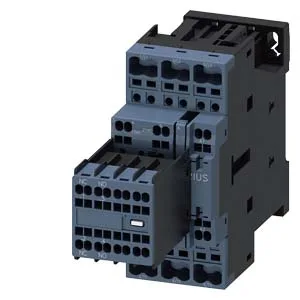
That's useful when you're squeezing it into a tight sub-panel or orienting it for cable entry. For the auxiliary contacts, 2x (0.5 to 2.5 mm²) solid or stranded. The spring terminals on the coil save time compared to screw clamps — no torque driver needed, just strip to 8 mm and push in. Clearance dimensions: 45 mm wide, 102 mm high, 144 mm deep. That 144 mm depth is the dimension to check against your enclosure depth — it's deeper than a typical slim relay, so account for it when laying out the DIN rail and wiring duct. If you're packing multiple contactors side-by-side, that 6 mm side gap is the tightest constraint — ignore it and you risk heat buildup or arc flashover between phases.
The 3RT2023-2AB04 carries a 24 VDC coil rated at 6 A. The DC switching ratings drop with voltage: 2 A at 48 V, 2 A at 60 V, 1 A at 110 V, 0.9 A at 125 V, 0.3 A at 220 V, 3 A at 400 V, and 0.6 A at 440 V. That's because DC arcs are harder to extinguish than AC — the same contactor that switches 7.6 A at 480 V AC will only handle 0.6 A at 440 V DC. If you're switching a DC motor or solenoid, use the DC column, not the AC rating. Arcing time is listed at 10 to 10 ms — that's tight and consistent, which helps with contact life in repetitive switching. The AC switching time is 4 to 16 ms, so the contactor closes and opens fast enough for most motor-starting and resistive-load applications.