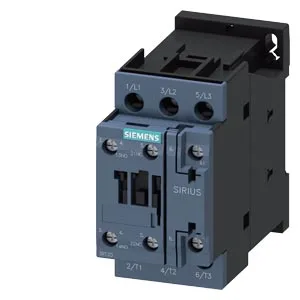
The auxiliary switch is integrated, saving a separate aux block purchase.
The auxiliary contact ratings tell you what loads the built-in switch can handle: it's rated 10 A at 24 V, 2 A at 48 V or 60 V, 1 A at 110 V, and 0.9 A at 125 V. At 400 V it carries 3 A, and at 480 V it's rated 7.6 A. These are the maximum currents the auxiliary contacts can break at those voltages — useful for pilot lights, PLC inputs, or relay coils in the control circuit. Switching frequency is rated up to 1 000 operations per hour for AC-1, AC-2, AC-3, and AC-3e duty, dropping to 300 per hour for AC-4 (plugging/inching). That means it handles continuous motor starting cycles well, but heavy reversing duty requires spacing out operations. Mechanical life is typical 10 000 000 operations, which is the contactor mechanism's endurance before wear-out — electrical life will be lower depending on load current and duty cycle.
This helps when fitting into tight or oddly oriented panel sections. The coil connection uses a ring cable lug.