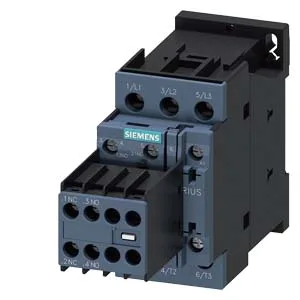
It mounts via screw or snap-on onto 35 mm DIN rail per DIN EN 60715, with a width of 45 mm and depth of 141 mm — that depth figure is the one to check against your gland plate clearance or enclosure depth before committing the BOM line. The coil is 24 VDC with screw-type terminals, and the main contacts use screw terminals accepting 1 to 10 mm² solid or stranded wire.
Mounting position allows +/-180° rotation on a vertical surface, plus forward/backward tilt of +/-22.5° on a vertical surface — useful when you're squeezing this into a crowded panel and need to angle the contactor for access. Clearance requirements: 10 mm upwards, 10 mm forwards, 10 mm downwards, 6 mm at the side. The S0 frame is a standard Siemens size; if you're replacing an older S0 contactor from another SIRIUS generation, the footprint and DIN rail clip are identical.
Operating conditions and switching performance
Operating temperature range is -25 to +60 °C, storage from -55 to +80 °C. Maximum mechanical switching frequency is 1 000 1/h for AC-1, AC-2, AC-3, and AC-3e duty; AC-4 drops to 300 1/h. Arcing time is 10 ms. The contactor is rated for 10 000 000 typical mechanical operations — that's the mechanical life, not electrical, so derate based on your switching load. Coil operating times at AC are 4 to 16 ms. Auxiliary switch: none built in, so plan an external auxiliary contact block if you need status feedback.