What it is and what it does
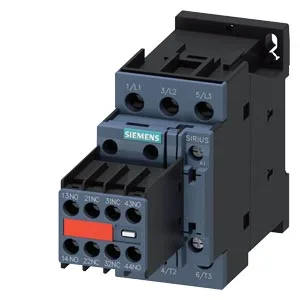
The Siemens 3RT2024-1CK64-3MA0 is a SIRIUS power contactor in the S0 frame size, designed for switching motor loads and resistive loads in industrial control panels. It uses screw-type terminals for the magnet coil and main circuit connections, and mounts via screw or snap-on onto 35 mm DIN rail per DIN EN 60715. The S0 frame is the compact footprint in the SIRIUS contactor family — 45 mm wide and 85 mm tall — so it fits standard 45 mm DIN-rail spacing alongside motor-protective breakers and overload relays in a motor control center. Operating temperature range is -25 to +60 °C, with storage from -55 to +80 °C. The mounting position is flexible: +/-180° rotation on a vertical surface, and can be tilted forward/backward by +/-22.5°.
Key ratings and what they mean for fit
This contactor carries no auxiliary switch block — it is a bare main contactor. If your circuit needs auxiliary contacts for status feedback or interlocking, you will add a separate block (Siemens 3RT29 series). Rated operational current at AC-3 (motor switching) is not directly listed in the excerpt, but the frame size S0 typically covers the 9–38 A range at 400 V. The 45 mm width confirms it is the smaller S0 variant, not the S2 or S3. Mechanical endurance is typical 10 million operations — the contactor is rated for high-cycle applications like conveyor or pump cycling within that limit. Switching frequency: 1000 cycles/hour at AC-1, AC-2, AC-3, and AC-3e; drops to 300 cycles/hour at AC-4 (plugging/inching duty). That derating matters if your application does frequent reversing or jogging.
Panel integration notes
Mounting: screw or snap-on onto 35 mm DIN rail. Clearance: 10 mm upwards, forwards, and downwards; 6 mm at the sides. Depth is 141 mm — check enclosure depth if using a shallow gland plate. Wire range: solid or stranded 1 to 10 mm² for main conductors. For finer control wiring, two conductors of 0.5 to 2.5 mm² per terminal are accepted. Arcing time is 4 to 16 ms at AC — ensure arc chute clearance per Siemens mounting guidelines.
