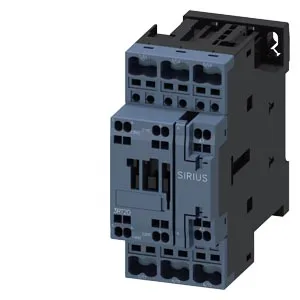
The coil is 24 VDC with spring-type terminals, meaning no screw tightening on the coil connection — just strip and push.
Switching frequency maxes at 1,000 cycles per hour for AC-1, AC-2, and AC-3 duty — that's about one cycle every 3.6 seconds, enough for most motor starting profiles. AC-4 (plugging/reversing) drops to 300 cycles per hour, reflecting the heavier arc wear from inching duty. Auxiliary contact ratings are given for DC switching: 10 A at 24 V, 2 A at 48 V, 1 A at 110 V, and 0.3 A at 220 V. That's the DC breaking capability — important if you're switching a PLC input or a DC relay coil in the same cabinet.
Wiring and panel integration
Main terminals accept solid or stranded conductors from 1 to 10 mm², and fine-stranded (with ferrule) from 0.5 to 2.5 mm² for the auxiliary circuit. The spring-type coil terminals take the same fine-stranded range. Arcing time is 10 ms, which is short — useful when coordinating with upstream short-circuit protection devices. That's the minimum air gap to grounded metal or other live parts — panel layout needs to respect those.