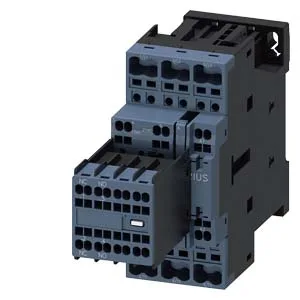
It mounts via screw or snap-on onto 35 mm DIN rail per DIN EN 60715, and the mounting position allows +/-180° rotation on a vertical surface plus +/-22.5° tilt forward and backward — useful when you're squeezing it into a crowded enclosure and need to orient the coil terminals where you can reach them. The magnet coil uses spring-type terminals, and the main contacts accept solid or stranded wire from 1 to 10 mm² (or 2x 0.5 to 2.5 mm² for finer stranded). That spring-cage termination means no screw-torque check during commissioning — strip, push, done.
Maximum switching rate is 1,000 operations per hour for AC-1 (resistive), AC-2 (slip-ring motor), AC-3 (squirrel-cage motor start/run), and AC-3e loads. For AC-4 (plugging/inching) the rate drops to 300 ops/h — that's the one that governs if you're doing frequent reversing or jogging. The arcing time sits at 10 to 10 ms on AC, which is tight and consistent; the contactor clears fast, which helps with contact life on inductive breaks.
Thermal limits and clearance requirements
That -55 °C storage limit matters if the spare sits in an unheated warehouse over winter — it's fine sitting there, just don't try to switch it until it's above -25. That 6 mm side gap is tighter than some contactors; you can pack them closer side-to-side if your heat rise checks out.