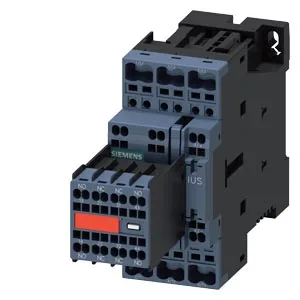
Its 24 VDC coil pulls in reliably at 80 % of rated voltage (19.2 V) and drops out below that threshold, giving a clean margin for brownout conditions.
DC switching — the rating that matters
This contactor's DC-1 switching capacity is what defines its real-world fit for DC circuits. At 24 V it handles 6 A; at 48 V and 60 V it drops to 2 A; at 110 V it's 1 A; at 220 V it's 0.3 A; at 400 V it's 3 A. The arcing time sits at 10 ms, and the opening time (DC) runs 15 to 18 ms. That arcing window is short enough that for most DC resistive loads you don't need an external snubber, but for inductive DC loads — solenoids, brake coils — a free-wheel diode across the load is still good practice. The spectrum doesn't lie: if you push 6 A at 48 V DC, the contacts will weld on the first open. The DC current derating curve is steep because DC arcs don't self-extinguish at zero crossing the way AC arcs do.
Mechanical and electrical endurance
Electrical life depends on the duty cycle: at AC-1 (resistive), AC-2 (slip-ring motor), AC-3 (squirrel-cage motor starting), and AC-3e (enhanced AC-3) the maximum is 1,000 operations per hour. At AC-4 (plugging/inching) the rate drops to 300 operations per hour. That 1,000 ops/h ceiling means this contactor is sized for moderate cycling — conveyor sections, pump starts, fan control — not for high-speed indexing or servo-motor switching where you'd need a dedicated DC switching device.
The Size S0 footprint — 45 mm wide, 102 mm high, 154 mm deep — fits standard 45 mm DIN-rail pitch.