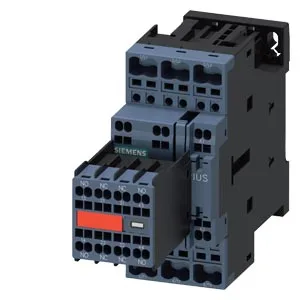
It mounts on 35 mm DIN rail per DIN EN 60715, using either screws or the snap-on latch, and the mounting position allows ±180° rotation on a vertical surface plus ±22.5° tilt forward and backward — useful when you're squeezing it into a tight gland plate layout. The contactor measures 45 mm wide, 102 mm tall, and 144 mm deep — a compact S0 footprint that leaves room alongside other SIRIUS gear in the same rail segment.
The magnet coil terminates in spring-type terminals — no screw torque to check, just strip and push. Main contacts accept solid or stranded wire from 1 to 10 mm², and the auxiliary circuit (if you add an auxiliary switch block later) accepts dual wires 2x (0.5 to 2.5 mm²). For North American practice, the main contact terminals also handle 18 to 8 AWG. That keeps the arc flash zone contained and lets you pack contactors side-by-side on the rail without derating.
This contactor is rated for motor duty at AC-3 (1,000 cycles/hour max) and the heavier AC-4 duty at 300 cycles/hour — the AC-4 limit matters for reversing or plugging applications where the contacts break full-load current. The AC-3e rating also sits at 1,000 cycles/hour, matching modern energy-efficient motor profiles. For the auxiliary contact side (if you wire it through a separate control circuit), the rated currents drop with voltage: 6 A at 24 V, 2 A at 48 V, 2 A at 60 V, 1 A at 110 V, 0.9 A at 125 V, 0.3 A at 220 V, 3 A at 400 V, and 0.6 A at 440 V. At 230 V it carries 2 hp — a common rating for small pump or fan motors.
The contactor carries no built-in auxiliary switch (: Auxiliary Switch = No), so if your circuit needs a mirror contact or a status feedback signal, you'll add a separate auxiliary switch block from the SIRIUS family.