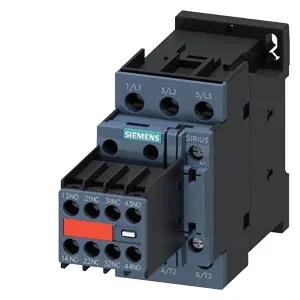
Switching rates tell you how hard you can work it: 1 000 operations per hour for AC-1 (resistive), AC-2 (slip-ring motor), AC-3 (squirrel-cage motor), and AC-3e (enhanced) duty. For heavy AC-4 duty (inching/plugging), the rate drops to 300 per hour — that's the limit for frequent reversals or jogging. The auxiliary contact ratings cover control-circuit switching: 6 A at 24 V, 2 A at 48 V and 60 V, 1 A at 110 V, 0.9 A at 125 V, 0.3 A at 220 V, and 0.6 A at 440 V (–). Note this contactor ships without a built-in auxiliary switch block — you'll need to add a separate 3RT19 series auxiliary contact block if your circuit requires feedback or status signaling.
The contactor accepts solid or stranded wire from 1 to 10 mm² for main power connections, and 2x (0.5–1.5 mm²) or 2x (0.75–2.5 mm²) for auxiliary circuits. Main contact terminal torque is 16–8 Nm — use a torque driver to avoid terminal damage. Screw-type coil terminals are standard; no push-in spring cages here. Side clearance to adjacent devices is 6 mm; top/bottom clearance 10 mm. Arcing time is 10–10 ms, with arc duration at AC of 4–16 ms.