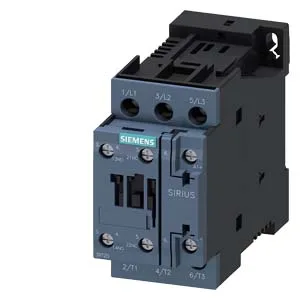
The coil is wound for 200–280 V AC, so it's a straight fit into 230 V or 277 V control circuits without a dropping resistor or transformer tap. Screw-type terminals on the magnet coil and main contacts accept solid or stranded wire from 1 to 10 mm², which covers most motor branch circuits up to about 7.5 kW at 400 V. The 45 mm width and 107 mm depth mean it occupies one standard 45 mm slot on the rail — no overhang into adjacent device space.
The 200–280 V AC coil range means this contactor pulls in reliably across the typical 230 V line variation (±10 %). The inrush current peak is 25 A, which the control transformer or PLC output must be able to deliver momentarily — a standard 24 VDC relay output won't drive this coil directly; you need an AC-rated output or an interposing relay. The arcing time is 10 ms, which is fast enough to limit contact erosion on resistive and motor loads. Switching frequency is rated at 1,000 operations per hour for AC-1, AC-2, AC-3, and AC-3e duty, dropping to 300 per hour for AC-4 (plugging/inching). That means for most motor starting (AC-3), you can cycle it every 3.6 seconds continuously without exceeding the thermal limit.
If you're looking at this part for a new design, the SIRIUS S0 platform is widely used across Siemens panels, so the 3RT2025-1NP30 is a safe choice for long-term support. The screw-type terminals are field-proven and easy to wire with standard tools. No special termination kits or adapter plates are needed.