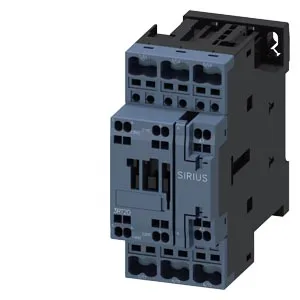
The coil termination uses spring-type terminals, which speeds up wiring compared to screw terminals and holds up better under vibration on a machine-tool panel or conveyor line.
At 24 V DC rated value, the contactor carries 10 A — that's the continuous current the main contacts can handle when the coil is held at 24 V DC. For a motor load, the AC-3 rating (not listed directly here but implicit in the S0 frame class) typically governs starting current; the 10 A DC figure is useful for DC load switching or for sizing the control transformer feeding the coil. At 480 V rated value, it handles 14 A — relevant for 480 V AC motor circuits common in North American installations. The 3 hp rating at 230 V rated value confirms it can drive a small three-phase motor at that voltage. The switching frequency limits are 1 000 operating cycles per hour for AC-1, AC-2, AC-3, and AC-3e duty, dropping to 300 cycles per hour for AC-4 (plugging/inching). That means for high-cycle applications like a rapid-indexing conveyor, you need to check the duty cycle against the AC-4 limit. That matters when you're squeezing a contactor into a tight corner of a retrofit panel and can't keep it perfectly upright.
That's a standard S0 frame envelope — fits alongside SIRIUS overload relays and aux contact blocks in a typical motor control center bucket or standalone panel. Those are the minimum air gaps for heat dissipation and arc containment — don't crowd it against cable ducts or other contactors without those clearances. Wire range accepts solid or stranded conductors from 1 to 10 mm², with a twin-wire capacity of 2x (0.5 to 2.5 mm²) for daisy-chaining control wiring. The spring-type terminals on the coil mean no screw-torque worries — just strip, insert, and pull to confirm lock.