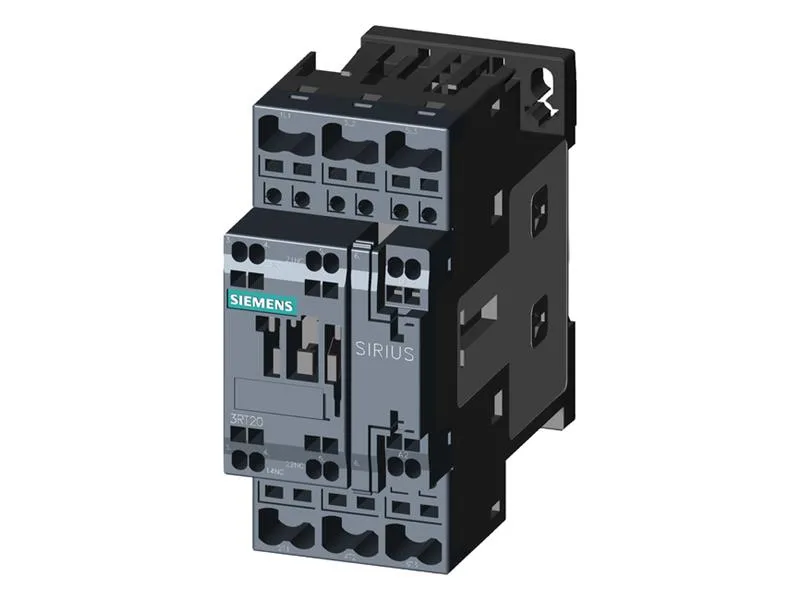
Rated for AC-3 duty at 1000 switching cycles per hour, this contactor handles the inrush of squirrel-cage motors during starting and disconnects under full load. The AC-4 rating drops to 300 1/h for plugging or inching applications where the motor is reversed or stopped under load.
The AC-3 rating is the one that decides motor-switching fit: at 400 V it's rated for 3 A, meaning it can start and stop a small induction motor of roughly 1.5 kW at that voltage. The 230 V rating of 3 hp confirms the same class of load on a 230 V single-phase or three-phase line. For resistive or general-purpose loads (AC-1), the contactor can cycle at 1000 1/h, but the current rating at 480 V is 14 A — that's the maximum continuous current the main contacts can carry in that duty class. The arcing time is a tight 10 ms, which keeps contact erosion low during normal break. The auxiliary contact ratings cover control voltages: 10 A at 24 V, 2 A at 48 V, 1 A at 110 V, and 0.3 A at 220 V. That's enough for a PLC output or a relay coil in most panels, but watch the DC rating if you're switching DC loads — the 24 V DC rating is 10 A, but at 48 V DC it drops to 2 A.
The main contact terminals accept 2x (0.5 to 2.5 mm²) solid or stranded. No screw torque to check — spring terminals save wireman time and hold better under vibration.