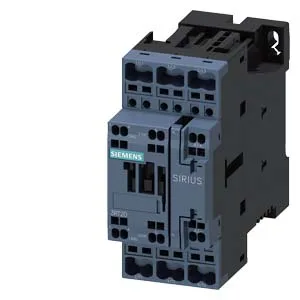
The 24 V DC coil pulls in reliably; the spring-type terminals (cage clamp) accept solid or stranded wire from 1 to 10 mm² on the main circuit, and dual 0.5 to 2.5 mm² on the auxiliary circuit — no screw torque to verify, which speeds panel assembly. Rated switching frequency hits 1,000 operating cycles per hour under AC-1, AC-2, AC-3, and AC-3e duty, and 300 cycles per hour under the heavier AC-4 category (plugging / inching). That AC-4 figure matters if your application does frequent reversing or jogging — the contactor is rated for it, not just occasional use.
That 6 mm side clearance means you can pack contactors side-by-side on the rail without wasting panel width — useful when racking multiple contactors in a motor control centre.
The main contacts are rated for AC-3 duty at 400 V, 3 A, and at 230 V it carries a 3 hp motor load — typical for a small conveyor drive or pump. For DC switching, the 24 V DC rating is 10 A, dropping to 2 A at 48 V and 60 V, 1 A at 110 V, 0.9 A at 125 V, and 0.3 A at 220 V. The DC derating curve is steep because DC arcs don't self-extinguish at zero-crossing; the contactor's arc chamber is sized for that, but don't expect the AC-3 current rating to hold on DC. That arcing time is consistent across the DC voltage range — the contactor clears the arc within one mains half-cycle equivalent. An auxiliary switch is built in (1 NO + 1 NC, per the 18-8 contact configuration), which saves a separate aux block for feedback to the PLC or status indication on the HMI.