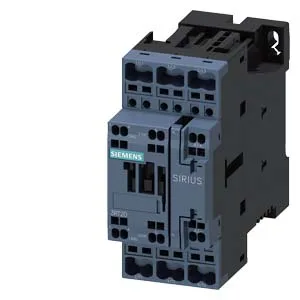
The Siemens SIRIUS 3RT2025-2BM40 is a Size S0 power contactor built for panel integration — 45 mm wide, 102 mm tall, 107 mm deep. It mounts via screw or snap-on onto 35 mm DIN rail per DIN EN 60715, and the mounting position is flexible: you can rotate it ±180° on a vertical surface or tilt it ±22.5° forward/backward. The coil connection uses spring-type terminals, so no screwdriver needed there. Main contacts accept solid or stranded wire from 1 to 10 mm², and auxiliary contacts can take 2×(0.5…2.5 mm²) solid or stranded. Switching frequency: 1 000 operating cycles per hour for AC-1, AC-2, AC-3, and AC-3e duty; drop to 300 1/h for AC-4. That means it handles high-rate motor starting (AC-3) without derating, but if you're jogging or inching (AC-4), you need to allow longer off-time between cycles.
Clearance and wiring
That's tight enough for most standard enclosures, but if you're stacking multiple S0 contactors side-by-side, the 6 mm side gap is the limiting factor — plan your DIN rail layout accordingly.
Environmental range
The auxiliary switch is rated for DC loads: 10 A at 24 V, 2 A at 48 V or 60 V, 1 A at 110 V, 0.9 A at 125 V, 0.3 A at 220 V, and 3 A at 400 V. These are the resistive (DC-13) values — if you're switching inductive DC loads (relay coils, solenoid valves), derate further or add a free-wheel diode.
That means it's still a standard catalogue item, not a phase-out risk for new designs or BOM freezes.