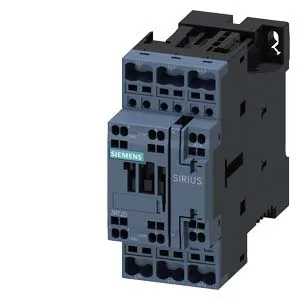
The contactor is rated for 1 000 switching cycles per hour under AC-1, AC-2, AC-3, and AC-3e duty, and 300 cycles per hour under AC-4. That means it handles frequent on-off cycles in a control scheme — think interposing relays or PLC-driven contactor banks — without exceeding thermal limits. The arcing time sits at 10 ms, consistent with a DC-coil dropout time of 19 to 21 ms, so the circuit opens cleanly within one mains half-cycle.
Auxiliary contact ratings — what they actually switch
The auxiliary contact set (no auxiliary switch fitted as standard per) is rated for DC switching at several voltage levels: 10 A at 24 V, 2 A at 48 V, 2 A at 60 V, 1 A at 110 V, 0.9 A at 125 V, 0.3 A at 220 V, and 3 A at 400 V. These are the make/break capacities for resistive DC loads — useful when the contactor drives a DC solenoid, a signal lamp, or a PLC input. The 3 A at 400 V rating also covers AC-1 resistive switching at that voltage level.