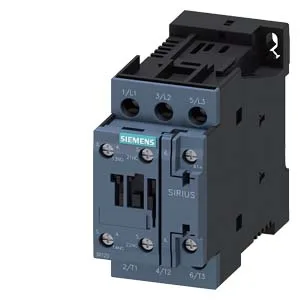
The 24 VDC coil pulls in at 0.8 × rated and drops out at 1.1 × rated — a 1.1 factor means the dropout threshold sits above nominal, so a sagging 24 V bus won't cause nuisance dropouts until the voltage rises above 26.4 V, which is a useful margin for DC-supply brownout ride-through.
Clearances and wiring
Main contact terminals accept solid or stranded wire 1 … 10 mm²; auxiliary terminals take 2 × (0.5 … 1.5 mm²) or 2 × (0.75 … 2.5 mm²). Arcing time sits at a tight 10 … 10 ms, and DC switching times run 15 … 18 ms — both figures matter for coordinating with upstream protection in a selective-coordination study.
Switching capacity and duty cycle
Rated operational current at 24 VDC is 10 A, derating to 2 A at 48 V and 60 V, 1 A at 110 V, 0.9 A at 125 V, and 0.3 A at 220 V. At 400 VAC the contactor switches 3 A. Motor rating: 3 hp at 230 VAC. Maximum switching frequency depends on duty: 1 000 ops/h for AC-1 (resistive), 750 ops/h for AC-2 and AC-3 (motor starting/running), 750 ops/h for AC-3e, and 250 ops/h for AC-4 (plugging/inching). Operating temperature range -25 … +60 °C; storage range -55 … +80 °C.