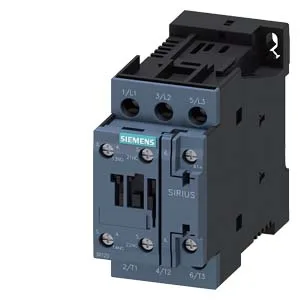
It snaps onto a 35 mm DIN rail per DIN EN 60715 or screws directly to the panel backplate — the S0 frame at 45 mm wide fits a standard 4-module slot on the rail.
The coil picks up at 0.8 × rated (19.2 VDC) and drops out at 1.1 × rated (26.4 VDC) — a standard 24 VDC control supply with 10 % ripple keeps it sealed. Main contacts accept solid or stranded wire from 1 to 10 mm² (roughly 16 to 8 AWG), and the auxiliary contact block takes 2 × 0.5 to 2.5 mm². Arcing time sits at 10 ms for AC loads and 15 to 18 ms for DC; that 18 ms DC arc is the figure to check if you are switching inductive DC loads on the auxiliary contact. Clearance spacing: 10 mm upwards, downwards, and forwards, 6 mm at the sides. Electrical life depends on duty: AC-1 (resistive) allows 1 000 ops/h, AC-2 and AC-3 (motor starting) cap at 750 ops/h, and AC-4 (plugging/inching) drops to 250 ops/h. For a conveyor drive cycling at 30 starts per hour, this contactor will outlast the motor overhaul interval.
The screw-and-snap DIN rail method is standard: hook the top clip, rotate down, and snap the bottom latch. No tools needed for the rail; the screw mount requires a 4.5 mm drill pattern.