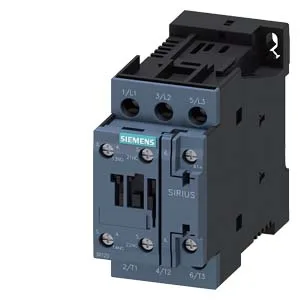
The contactor mounts via screw or snap-on onto 35 mm DIN rail per DIN EN 60715, and its mounting position allows ±180° rotation on a vertical surface plus ±22.5° tilt forward/backward — useful when fitting into existing panel layouts where the rail orientation isn't perfectly plumb. The S0 frame keeps the envelope compact at 45 mm wide × 85 mm high × 107 mm deep, so it fits standard 45 mm-wide DIN-rail slots without crowding adjacent devices.
The 3RT2026-1BJ80 is rated for DC switching at several voltage levels: 10 A at 24 V, 2 A at 48 V and 60 V, 1 A at 110 V, 0.9 A at 125 V, 0.3 A at 220 V, and 3 A at 400 V. These are the DC-1 (resistive) or DC-13 (solenoid/electromagnetic) values depending on the load — for motor loads, the AC ratings govern. Maximum switching frequency varies by duty class: 1,000 operations per hour at AC-1 (resistive), 750/h at AC-2 and AC-3 (motor starting/running), 750/h at AC-3e, and 250/h at AC-4 (plugging/inching). The arcing time is 10 ms, and the DC dropout time is 15–18 ms. For a motor starter application, the AC-3 figure of 750/h is the one that governs — that's about one start every 4.8 seconds sustained, which covers most conveyor and pump cycles.
Auxiliary switch terminals accept dual conductors: 2×(0.5–1.5 mm²) or 2×(0.75–2.5 mm²). The screw-type terminal design is field-proven for panel wiring with ferruled stranded or solid copper. These are the minimum air gaps to adjacent metalwork or other devices — important when packing multiple contactors on a DIN rail to avoid arc flash between phases.