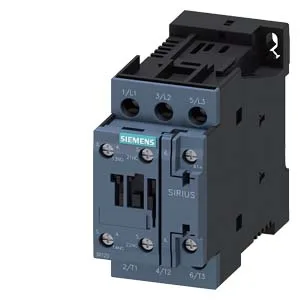
It's an active-production part, so you're not hunting for NOS or surplus — it's a current catalog line. The coil is rated at 48 V DC, with screw-type terminals. That 48 V coil makes it a fit for control systems running a 48 VDC bus — common in some industrial and rail-adjacent applications — rather than the more typical 24 VDC or 110 VAC coils you see on the shelf.
That's tight enough to stack contactors side-by-side in a multi-pump starter section without wasting rail space.
For motor starting duty (AC-3), the contactor is rated for 750 operating cycles per hour. That's about one start every 4.8 seconds — plenty for a conveyor or pump cycling on a level control, but if you're doing rapid reversing on a positioning axis (AC-4), the rate drops to 250 cycles per hour, so plan accordingly.
For the coil and auxiliary circuit, you can land 2x (0.5 to 1.5 mm²) or 2x (0.75 to 2.5 mm²) — handy for daisy-chaining control wiring without a separate terminal block. The contactor's dropout time on DC is 15 to 18 ms, and arcing time is 10 ms. That's fast enough for most emergency-stop circuits, but if you're coordinating with a safety relay that expects a faster break, verify the timing against your safety PLC's input filter settings.
Sourcing Reality
If you're comparing it to the 3RT2026-1KB40 (which carries a 24 VDC coil), the mechanical footprint and wiring are identical — same S0 frame, same DIN rail clip, same wire ranges. The only decision is your control voltage: 48 VDC vs 24 VDC. No rewiring required to swap between them on the power side, just the coil supply.