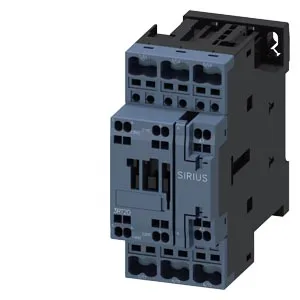
S0 frame, 18-8 A main contacts — what fits where
The 3RT2026-2AL20-ZW96 is a Siemens SIRIUS power contactor in the S0 frame size — the smallest of the SIRIUS contactor family, sized for control panels where DIN-rail real estate is tight at 45 mm wide. Main contacts are rated 18-8 A, which means it handles motor starting and resistive loads up to that current range, but the actual continuous current depends on the duty cycle — AC-1 (resistive) allows up to 1000 switching cycles per hour, while AC-3 (motor) and AC-4 (inching/plugging) cap at 750 and 250 cycles per hour respectively. Coil termination uses spring-type terminals — no screw torque to set, just push the stripped wire in, which speeds up panel wiring but means you need a ferrule on stranded wire for a reliable grip.
Mounting and clearances — panel fit checklist
Mounts via screw or snap-on onto 35 mm standard DIN rail per DIN EN 60715 — the snap-on foot saves rail space versus a screw-clamp base, but the screw option gives a positive lock in high-vibration environments. Clearance requirements: 10 mm upwards, 10 mm forwards, 10 mm downwards, and 6 mm at the side — that 6 mm side gap is tight; in a packed panel, adjacent devices on the same rail need that breathing room for heat dissipation and arc flash containment. Mounting position is flexible — +/-180° rotation on a vertical surface, and can be tilted forward/backward by +/-22.5° on a vertical mounting surface, which matters when you're fitting it into a sloped enclosure backplate. Wire range: accepts solid or stranded conductors from 1 to 10 mm², and up to 2x 0.5-2.5 mm² for daisy-chaining control wiring — the spring terminals handle that range without needing to strip different lengths.
Switching rates and thermal limits — duty cycle reality
Maximum switching rate depends on the load type: 1000 cycles/hour for AC-1 resistive loads, 750 cycles/hour for AC-2 and AC-3 motor duty, and only 250 cycles/hour for AC-4 inching or plugging — that AC-4 limit is the one that catches people out on reversing starter applications. Operating temperature range is -25 to +60 °C during operation, with storage from -55 to +80 °C — the -25 °C lower limit means it's fine for unheated plant rooms but not for outdoor cabinets in freezing climates without a heater. Arcing time is 10-10 ms at 50/60 Hz — that's a tight window, meaning the arc extinguishes quickly, which helps with contact life but also means the downstream overload relay needs to coordinate within that arc energy.