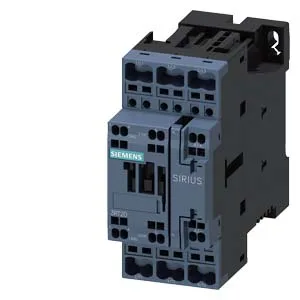
It carries a 110 V AC coil and uses spring-type terminals for the main and auxiliary circuits — no screwdriver needed, which speeds up panel wiring and cuts down on loose connections out here in the grease. Rated for a coil pickup at 0.8 x rated voltage and a dropout at 1.1 x full-scale, it holds in across the -25 to +60 °C operating range — wide enough for most cabinet environments without forced cooling.
The 110 V AC coil draws its rated value at 110 V; the contactor handles 10 A at 24 V DC, 2 A at 48 V and 60 V DC, 1 A at 110 V DC, 0.9 A at 125 V DC, 0.3 A at 220 V DC, and 3 A at 400 V AC — so it's sized for moderate motor loads and control circuits, not high-current feeders. Mechanical life is rated at 10 million operations typical, with switching frequencies up to 1000 cycles per hour at AC-1 (resistive) and 750 per hour at AC-3 (motor). That's enough for frequent cycling on a conveyor or pump station, but if you're hammering it at AC-4 (plugging/reversing) you're limited to 250 per hour — plan the duty cycle accordingly.
The S0 footprint is 45 mm wide, 102 mm tall, 107 mm deep — fits standard panel spacing, but watch the 107 mm depth when the gland plate or door is tight. That's lean enough for dense rail packing, but don't crowd the arc chute side — arcing time runs 10 to 10 ms, and the magnetic blowout needs room to stretch the arc.
Spring-type terminals accept solid or stranded wire from 1 to 10 mm², and you can land two conductors of 0.5 to 2.5 mm² each in the same clamp — handy for daisy-chaining control power or looping through an auxiliary contact.