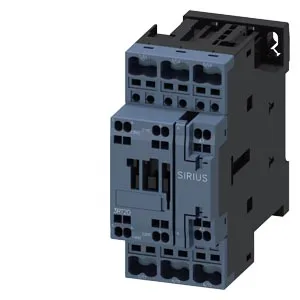
It uses spring-type terminals for the magnet coil, which speeds up wiring compared to screw-clamp versions — no torque driver needed, just strip and push. The contactor snaps onto a 35 mm DIN rail per DIN EN 60715 and can also be screw-mounted; the mounting position allows +/-180° rotation on a vertical surface and +/-22.5° tilt forward or backward, giving panel builders flexibility in tight enclosures.
The electrical endurance varies by duty: AC-1 (resistive loads) allows up to 1,000 operations per hour, AC-2 and AC-3 (motor starting and running) allow 750 ops/h, and AC-4 (plugging or inching) drops to 250 ops/h. The AC-3e rating at 750 ops/h matches the standard AC-3 figure, confirming this is the motor-duty workhorse rating. For a 230 V motor load, the contactor is rated at 3 hp; at 400 V it handles 3 A in the auxiliary contact circuit. The 24 V rated value of 10 A on the auxiliary switch means it can drive smaller control loads directly without an interposing relay. That 97 mm depth and 45 mm width mean it fits standard S0-size contactor slots in pre-drilled panel layouts. The spring terminals accept solid or stranded wire from 1 to 10 mm², and for the auxiliary circuit they accept 2x 0.5 to 2.5 mm² solid or stranded — so no special ferrules needed for the smaller control wiring.