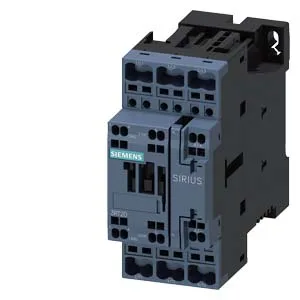
It's sized for switching DC loads up to 10 A at 24 V, 2 A at 48 V, and 0.3 A at 220 V — so it handles solenoid valves, brake coils, and small DC motor circuits in control panels. The S0 frame (45 mm wide, 102 mm tall, 107 mm deep) snaps onto standard 35 mm DIN rail per DIN EN 60715, and the mounting position is flexible: ±180° rotation on a vertical surface, plus ±22.5° tilt forward/backward. That's useful when you're squeezing it into a crowded gland plate area.
Switching frequency and duty cycle — the real limit
This contactor's maximum switching rate depends on the duty category. In AC-1 (resistive loads) it can cycle 1,000 times per hour. For AC-2 and AC-3 (motor starting and running) it drops to 750 operations per hour. AC-4 (plugging, inching) is the hardest — only 250 cycles per hour. The AC-3e rating (750/h) mirrors the standard AC-3 figure. If your application needs frequent jogging or reversing, the 250/h ceiling on AC-4 is the number that governs real panel life — not the AC-1 headline.
For auxiliary circuits, twin wires 2x (0.5 to 2.5 mm²) are supported. The spring cage eliminates screw-torque checks — good for high-vibration panels or fast assembly lines. Clearance distances: 10 mm upward, downward, and forward; 6 mm at the sides. That's tight enough for a standard DIN-rail layout without forced spacing.
Environmental range
Storage range is wider: -55 to +80 °C — that's the handling and shipping limit, not the running limit.