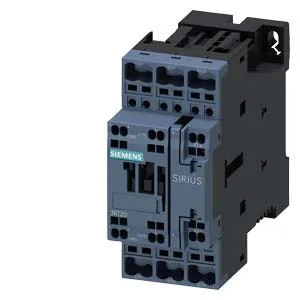
The S0 frame keeps the width to 45 mm, making it a standard fit for compact motor control center buckets and panel layouts where panel space is tight.
Coil pickup is specified at 0.7 of rated voltage (about 16.8 V for a 24 V nominal coil), and the dropout threshold sits at 0.2 of rated value — so the contactor holds in through dips down to roughly 4.8 V. That's a wide hysteresis, which matters if your control transformer is shared with other inductive loads that sag the bus on pickup. The coil draws a 3 A inrush peak, then settles to a holding current that stays within the 21-28 V range. Spring-type terminals on the coil mean no screw tightening — strip to 8 mm and push in — which shaves a few seconds per termination on a multi-contactor panel. Main contact ratings are given per duty cycle: AC-1 resistive loads at 1,000 operations per hour max, AC-3 motor switching at 750 ops/h, and AC-4 (plugging/reversing) at 250 ops/h. The AC-3e maximum matches the AC-3 figure at 750 ops/h. Switching capacity on the auxiliary contacts is rated at 10 A at 24 V, 2 A at 48 V or 60 V, and 1 A at 110 V — all DC resistive. If you're switching an inductive DC load like a brake coil or a DC solenoid, you'll want to derate further or add a free-wheel diode across the load.
Those clearances are for heat dissipation and arc flash — stacking contactors tighter than that without derating will shorten coil life. Conductor range: solid or stranded 1-10 mm² on the main terminals, and 2x (0.5-2.5 mm²) on the auxiliary/coil terminals. Spring terminals accept ferruled stranded wire without issue — just make sure the ferrule length matches the strip length for a positive seat.