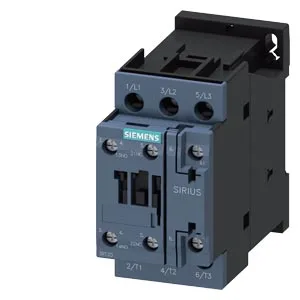
The coil connection uses a ring cable lug — verify you have the correct lug size on the van before you start.
Mounting and spacing
That helps when you're fitting it into a cramped corner of the enclosure.
Switching performance and auxiliary contacts
Arcing time is a tight 10 to 10 ms, which means consistent arc extinction across the load range. Maximum operating frequency varies by duty: 1000 cycles/hour at AC-1 (resistive), 750 cycles/hour at AC-2 and AC-3 (motor starting and running), and 250 cycles/hour at AC-4 (plugging and inching). For AC-3e (high-efficiency motors), it's also 750 cycles/hour.
Rated operational currents across voltages
The contactor's current rating varies with voltage and duty. At 24 V it carries 10 A; at 48 V and 60 V, 2 A; at 110 V, 1 A; at 125 V, 0.9 A; at 220 V, 0.3 A; at 400 V, 3 A; at 440 V, 0.6 A; at 480 V, 21 A; at 500 V, 2 A. The 480 V 21 A peak is the headline motor rating — the lower values at intermediate voltages reflect different load types or contact gaps optimized for the 480 V coil tap. Coil ratings: 200 V at 50 Hz, 220 V at 60 Hz. The coil pick-up time is 4 to 16 ms at AC, and the holding power is 0.25 VA at 50 Hz, 0.28 VA at 60 Hz — low enough that the control transformer doesn't need upsizing.