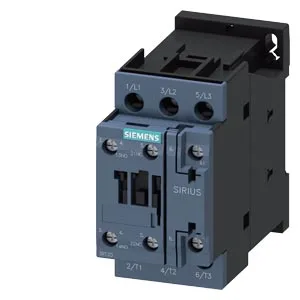
What It Is & Where It Goes
It's the workhorse for switching motor loads, resistive heaters, and other inductive or resistive circuits inside a control panel. The S0 size is the compact footprint in the SIRIUS family — 45 mm wide, 85 mm tall, 107 mm deep — so it fits standard 35 mm DIN rail (DIN EN 60715) with either screw-fixed or snap-on mounting.
Coil & Control Circuit
The coil is rated at 24 VDC nominal. At that rated voltage, the contactor can switch 10 A on the main contacts. The coil connection uses a ring cable lug, which is a solid, vibration-resistant termination — good for panels that see transport or machine vibration. That's fast enough for most sequencing and interlocking schemes.
Switching Capacity & Duty Cycles
The contactor is rated for different switching frequencies depending on the load category. For AC-1 (resistive loads), it can handle up to 1,000 operations per hour. For AC-3 (squirrel-cage motor starting) and AC-2 (slip-ring motor starting), it's rated at 750 ops/h. For AC-4 (plugging, inching, reversing), the rate drops to 250 ops/h — that's the heavy-duty cycle where the contacts take more wear. The mechanical life is typical for the class at 10 million operations, so the limiting factor is electrical wear under load, not the mechanism.
Environmental & Clearance
These matter for heat dissipation and arc flash containment — don't crowd the contactor below those numbers, especially in a high-duty-cycle application.
Auxiliary Contacts
The contactor comes with an integrated auxiliary switch. That's a standard feature on this variant — you don't need to order a separate side-mount block for basic status feedback or interlocking. The auxiliary contacts are rated for various DC voltages: 2 A at 48 V, 2 A at 60 V, 1 A at 110 V, 0.9 A at 125 V, 0.3 A at 220 V, 0.6 A at 440 V, and 2 A at 500 V. For AC motor control at 480 V, the auxiliary is rated at 21 A; at 600 V, it's 22 A. That's enough for pilot duty on most PLC inputs or relay coils.