What it is and what it does
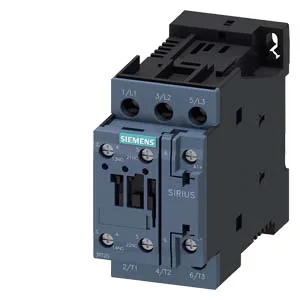
The Siemens SIRIUS 3RT2027-1BB40-0CC0 is a Size S0 power contactor with a 24 VDC coil, designed for switching motor loads and other inductive loads in industrial control panels. It mounts on a standard 35 mm DIN rail per DIN EN 60715, with screw and snap-on fastening. The contactor is rated for motor duty up to 5 hp at 230 V, and its auxiliary contact block handles 10 A at 24 V, stepping down to 0.3 A at 220 V.
Key ratings and what they mean for your panel
The 24 VDC coil is a common control voltage in modern PLC-driven panels — it keeps the control circuit isolated from the line voltage and is standard across most automation architectures. The Size S0 frame (45 mm wide, 85 mm tall, 107 mm deep) fits into a compact DIN-rail footprint, leaving room for adjacent motor starters or overload relays in a crowded enclosure. Switching frequency varies by duty class: up to 1,000 operations per hour for AC-1 resistive loads, 750 ops/h for AC-2 and AC-3 motor starting, and 250 ops/h for AC-4 plugging/reversing. For a conveyor line running at 750 cycles per hour under AC-3 duty, this contactor keeps up without derating. The mechanical service life is rated at 10 million operations typical, so it outlasts most panel rebuild cycles. Wire termination uses screw-type terminals on the main contacts, accepting solid or stranded conductors from 1 to 10 mm². For fine-stranded wire, it handles 2x (0.5 to 1.5 mm²) or 2x (0.75 to 2.5 mm²) — useful when paralleling control wiring through the same terminal. The auxiliary switch is integrated, so you don't need a separate add-on block for basic status feedback.
Where it goes and how it mounts
Mounting position is flexible: the contactor can be rotated ±180° on a vertical surface, or tilted forward/backward by ±22.5°. This matters when you're retrofitting into an existing panel where the DIN rail is already oriented. Clearances around the contactor are specified: 10 mm upwards, downwards, and forwards, and 6 mm at the side — plan your gland plate and wireway accordingly. Operating temperature range is -25 to +60 °C, with storage from -55 to +80 °C. If your panel sits near a furnace line or in an unventilated cabinet in a hot climate, the upper operating limit of 60 °C is the hard ceiling — derate switching frequency if ambient exceeds 40 °C.
