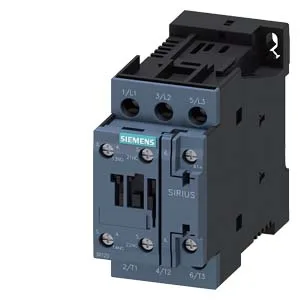
It snaps onto a 35 mm DIN rail per DIN EN 60715, and its mounting position is flexible — it can be rotated ±180° on a vertical surface and tilted ±22.5° forward or backward. This makes it straightforward to integrate into a control panel layout where space or orientation is tight.
The 24 VDC coil has a pickup factor of 0.8 and a drop-out factor of 1.1, meaning it pulls in reliably at 80% of nominal (19.2 V) and drops out at 110% (26.4 V). That gives you a solid hold-in margin even on a lightly loaded DC supply.
Switching Frequency and Duty Cycles
Maximum switching frequency depends on the load category: 1,000 cycles/hour for AC-1 resistive loads, 750 cycles/hour for AC-2 and AC-3 motor loads, and 250 cycles/hour for AC-4 (plugging/inching). If your conveyor zone is doing frequent reversing or jogging, stay under the AC-4 ceiling to avoid overheating the coil and contacts.
Mechanical Endurance and Temperature Range
Main contacts accept 16 to 8 AWG solid or stranded (1 to 10 mm²). Auxiliary contacts accept 2x (0.5 to 1.5 mm²) or 2x (0.75 to 2.5 mm²) solid or stranded. That covers most control wiring from 16 AWG thermostat wire up to 8 AWG motor leads. The screw-type terminals are familiar to any panel wireman — no special tooling needed.
Clearance Requirements for Panel Layout
That 6 mm side gap is tighter than the vertical ones — if you're packing contactors side-by-side on a DIN rail, leave at least 6 mm between them for airflow and arc-chamber venting.