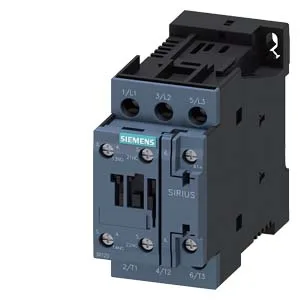
The contactor carries a full-scale factor of 1.1, meaning it can handle continuous current up to 110% of its rated value without tripping — useful for motor starting inrush. Rated operating time at DC is 15 to 18 ms, and arcing time is 10 ms, both typical for this class of IEC contactor.
At 24 V DC the contactor is rated 10 A — that's the auxiliary contact current capacity, not the main pole rating. For main contact switching, the 230 V AC rating is 5 hp (approx 3.7 kW motor), and at 400 V AC it's rated 3 A. The auxiliary switch is present (yes), wired with 2x (0.5 to 1.5 mm²) or 2x (0.75 to 2.5 mm²) solid or stranded. Mechanical life is typical 10 million operations, and maximum operating frequency varies by duty: AC-1 resistive loads up to 1000 cycles/hour, AC-2 and AC-3 motor switching up to 750 cycles/hour, and AC-4 plugging/reversing up to 250 cycles/hour. The AC-3e rating also caps at 750 cycles/hour — that's the energy-efficient motor switching variant.
Main contact wire range is 1 to 10 mm² solid or stranded; auxiliary contacts accept 2x (0.5 to 1.5 mm²) or 2x (0.75 to 2.5 mm²). The coil terminal type is screw-type, so expect standard screwdriver termination — no spring-cage on this variant.