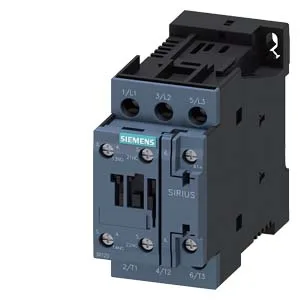
The Siemens 3RT2027-1BJ80 is a SIRIUS-brand power contactor in the Size S0 frame, with a 24 VDC-rated magnet coil terminated via screw-type terminals. It mounts onto a 35 mm DIN rail per DIN EN 60715, either screw-fixed or snapped on, and accepts ±180° rotation on a vertical surface with ±22.5° tilt allowance — useful when panel layout forces an unconventional orientation. Rated for DC-13 duty at 24 V at 10 A, this contactor handles solenoid and electromagnetic brake loads common in packaging and material-handling lines.
Clearance and wiring constraints
Side clearance to adjacent devices is 6 mm; vertical (up/down) clearance is 10 mm each, and forward clearance is also 10 mm. That 6 mm side gap is tighter than some S0 peers — if you're packing multiple contactors side-by-side, check that the auxiliary switch (present on this unit) doesn't overhang into the next slot. Main contacts accept solid or stranded wire from 1 to 10 mm²; auxiliary contacts take 2x (0.5 to 1.5 mm²) or 2x (0.75 to 2.5 mm²). The screw terminals are the standard captive type — no spring-cage here, so budget for screwdriver time if the panel spec calls for tool-less wiring.
Maximum switching rate is 1,000 cycles/hour at AC-1 (resistive loads), 750 cycles/hour at AC-3 (squirrel-cage motor starting), and 250 cycles/hour at AC-4 (plugging/inching). Arcing time is 10 ms; dropout time at DC is 15 to 18 ms. Those numbers matter if you're coordinating with a safety relay or a downstream contactor — the dropout delay is consistent enough for basic category 3 or 4 circuits, but verify the total off-delay against your safety PLC's tolerance.