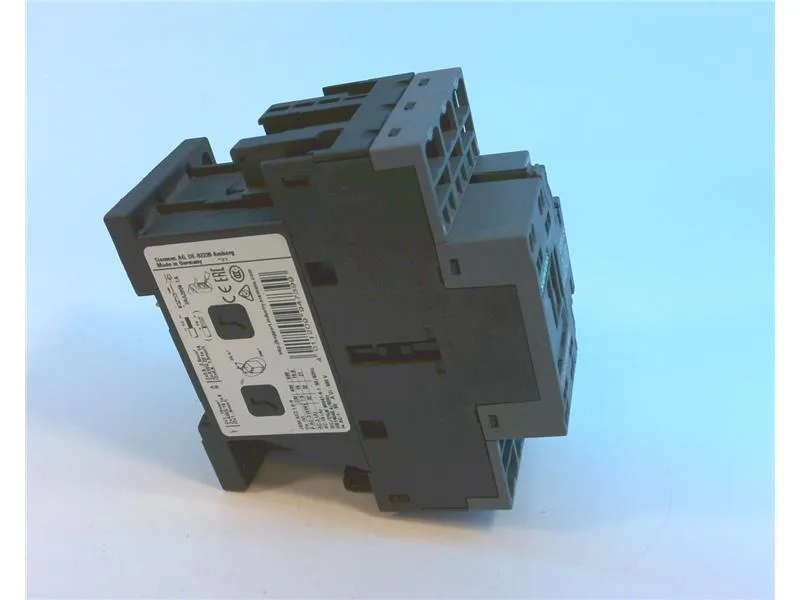
The magnet coil uses spring-type terminals, so you're wiring the control circuit without a screwdriver — just strip, push, and pull to verify the hold.
This contactor occupies 45 mm of DIN rail width, with a depth of 144 mm and height of 102 mm — that's a standard S0 footprint, so it fits alongside other SIRIUS S0 gear without surprises on the layout. The main contacts accept solid or stranded wire from 1 to 10 mm², and you can double up 2x (0.5 to 2.5 mm²) on the same terminal if you're looping through. The auxiliary contact block is not included (: No auxiliary switch), so if your circuit needs a feedback contact, you'll add a separate block on the front or side. Switching frequency depends on the duty class: at AC-1 (resistive loads) it's rated for 1,000 operations per hour maximum; at AC-3 (standard motor starting) it's 750 ops/h; at AC-4 (plugging or inching) it drops to 250 ops/h. That AC-3 ceiling of 750 cycles per hour is typical for a contactor this size — enough for a conveyor start/stop cycle every 4.8 seconds, but not for high-speed indexing. The rated operational current at 50 Hz is 0.25 A and at 60 Hz is 0.28 A, which reflects the coil draw, not the main contact rating. The contactor is rated for a 5 hp motor at 230 V, and the auxiliary contact ratings span from 6 A at 24 V down to 0.3 A at 220 V, with specific values at 48 V (2 A), 60 V (2 A), 110 V (1 A), 125 V (0.9 A), 400 V (3 A), and 440 V (0.6 A). Those are the make/break capacities for the integrated auxiliary contacts — use them for PLC inputs or relay coils, not motor loads. Mechanical endurance is typical 10 million operations, so it'll outlast most machines if the electrical load stays within the AC-3 curve.
Where this class of part is used
Power contactors like this one are the workhorses inside motor control centers, pump panels, conveyor control cabinets, and HVAC starter assemblies.