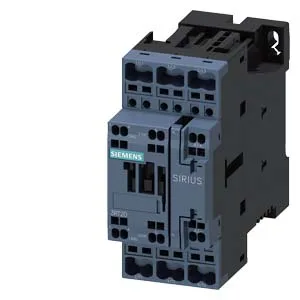
It carries a 24 V DC coil with spring-type terminals — no screwdriver needed for the coil connection, which saves a few seconds per wire on a build-out. The contactor snaps onto 35 mm DIN rail per EN 60715 and can also be screw-mounted; the mounting position allows ±180° rotation on a vertical surface plus ±22.5° tilt forward and back, so it fits tight enclosures without forcing the bus. Rated operating current for the main contacts isn't listed directly, but the switching frequency tells the duty story: 1000 operations per hour at AC-1 (resistive), 750 at AC-2 and AC-3 (motor start/run), and 250 at AC-4 (plugging/inching). That AC-3 ceiling of 750 ops/h is typical for a general-purpose motor contactor — enough for a conveyor or pump cycling every few seconds, but not for a high-speed pick-and-place.
Terminal and wiring detail — spring-cage on the coil, screw on the main
Coil connection uses spring-type terminals. Auxiliary switch terminals accept 2x 0.5 to 2.5 mm². In a packed panel, that means you can butt this contactor against the next device or the gland plate as long as you respect the 6 mm side gap.
Coil and auxiliary contact ratings
Coil picks up at 0.8 x rated voltage and drops out at 1.1 x rated. Drop-out time on DC is 15 to 17.5 ms; arcing time is 10 ms. The integrated auxiliary switch is rated for 10 A at 24 V, 2 A at 48 V and 60 V, 1 A at 110 V, 0.9 A at 125 V, 0.3 A at 220 V, and 3 A at 400 V. It also carries a 5 hp rating at 230 V. That covers most PLC input and pilot-duty loads without needing a separate auxiliary block.
This part is current production.