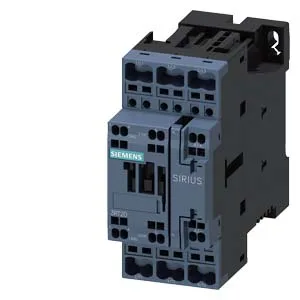
It's a current-production part, so you're not hunting NOS or surplus for this one. The 110 VAC coil is rated at 0.8 times the rated value for pickup and 1.1 times for the full-scale value, meaning it'll pull in reliably on a sagging line but won't cook if the transformer runs a touch high. The spring-type terminals on the magnet coil and main contacts accept solid or stranded wire from 1 to 10 mm², or 2x (0.5 to 2.5 mm²) for daisy-chaining control wiring.
The S0 footprint is 45 mm wide, 102 mm tall, 107 mm deep — it'll fit a standard 8-inch deep enclosure with room for the gland plate. That's tight enough to pack contactors side-by-side in a multi-motor starter bucket without cooking each other.
Switching capability and life
Main contacts rated AC-1 at 18 A, AC-3 at 8 A — that's the motor-switching number that matters for a 5 hp, 230 V single-phase or a small three-phase motor. The 10 million mechanical operations typical life means it'll outlast the machine it's in, assuming you're not cycling it every 10 seconds. Switching frequency: 1,000 ops/hour at AC-1, 750 at AC-2 and AC-3, 250 at AC-4. If you're jogging or inching a load, stay under 250 cycles per hour or the arc chute will cook. Auxiliary switch is included, rated at 10 A at 24 V, 2 A at 48/60 V, 1 A at 110 V, 0.9 A at 125 V, 0.3 A at 220 V, and 3 A at 400 V. That covers most PLC input and relay coil loads without an interposing relay.
Environmental tolerance
That's fine for a non-condensing panel next to a hot motor or in an unheated warehouse. The arcing time is a tight 10 to 10 ms — consistent, which helps with contactor life on inductive loads. Pickup and dropout timing on DC is 15 to 18 ms — snappy enough for most sequencing, but if you're coordinating with a safety relay, account for that window in your timing budget.