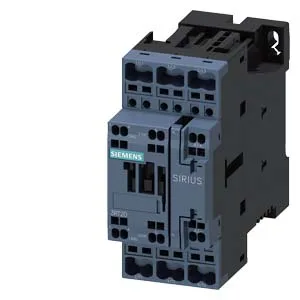
The 3RT2027-2BM40-ZW97 is a Siemens SIRIUS size S0 power contactor with a 220 V AC coil and spring-type terminals.
The AC-3 rating (motor starting, breaking under load) maxes out at 750 operating cycles per hour — that's a cycle every 4.8 seconds, which covers most pump and fan duty. If you're doing plugging or inching (AC-4 duty), the rate drops to 250 ops/h because the contactor takes more heat on each break. The coil picks up at 0.8x rated voltage (176 V for a 220 V coil) and holds in at 1.1x, so it stays latched through moderate sags. Dropout time on DC is 15 to 17.5 ms, arcing time a tight 10 ms — that tells you the arc chute does its job quickly, which matters for contact life. The spring terminals accept solid or stranded wire from 1 to 10 mm², and you can land two conductors of 0.5 to 2.5 mm² in the same clamp — handy for daisy-chaining control power.
Mounting and clearance: what the panel needs
That's minimal for a 45 mm wide device; you can pack them close if you watch the heat rise.
Switching capability across voltages
The auxiliary contacts are rated for inductive DC switching: 10 A at 24 V, 2 A at 48 V and 60 V, 1 A at 110 V, 0.9 A at 125 V, 0.3 A at 220 V, and 3 A at 400 V. At 230 V AC the contactor is rated for 5 hp motor load. These numbers matter if you're using the auxiliary for a DC brake coil or a small contactor pilot — don't assume the AC rating carries over to DC; the arc extinction is different, and the DC ratings here are the real limit.
Mechanical endurance and operating rates
The electrical operating rate depends on duty: 1,000 ops/h for resistive (AC-1), 750 ops/h for motor starting (AC-2 and AC-3), and 250 ops/h for AC-4 (inching/plugging). If your application cycles faster than these rates, the contactor can overheat internally even if the load current is within rating. Stick to the rate limits for reliable service.