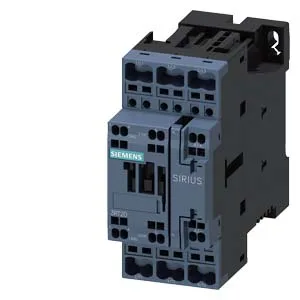
What the DC switching ratings mean
The 3RT2027-2BW40: The DC switching table tells you the maximum current this contactor can break at each DC voltage level: 10 A at 24 V, 2 A at 48 V, 2 A at 60 V, 1 A at 110 V, 0.9 A at 125 V, 0.3 A at 220 V, and 3 A at 400 V. These are the interrupting limits for DC loads — inductive DC loads (like brake coils or DC motor fields) will need additional suppression or derating. The arcing time is 10–10 ms, consistent with a DC-rated contactor.
Switching frequency by duty class
Maximum switching rate depends on the load duty: 1,000 operations per hour at AC-1 (resistive), 750/h at AC-2 and AC-3 (motor starting/running), and 250/h at AC-4 (plugging, inching). For AC-3e (enhanced motor starting) it's also 750/h. If your application cycles faster than these limits, the contactor will overheat — size up or reduce the rate.
Panel integration — DIN rail and wire
That helps when the panel layout is tight. Main contact wire range is 18–8 AWG solid or stranded (1–10 mm²). The spring-type coil terminals accept 2x (0.5–2.5 mm²) solid or stranded.