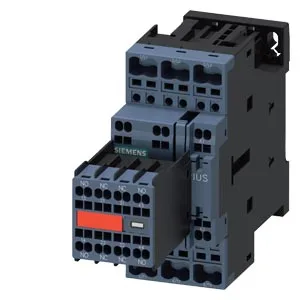
The coil connection uses spring-type terminals, which speeds wiring and holds up better under vibration than screw clamps — a detail that matters when the panel sees fork-truck rumble or conveyor line chatter.
The contactor is rated for AC-3 motor switching at up to 750 operations per hour, and AC-1 resistive loads at up to 1 000 cycles per hour. Those are the duty-class limits that govern real-world coil and contact life — the AC-3 figure is the one you size against for a motor start/stop application, not the higher AC-1 number. The arcing time is specified at 10 ms, which is tight enough to keep contact erosion predictable in a standard 50/60 Hz line.
The contactor accepts solid or stranded conductors from 1 to 10 mm² on the power circuit, and 2x (0.5 to 2.5 mm²) on the auxiliary circuit.