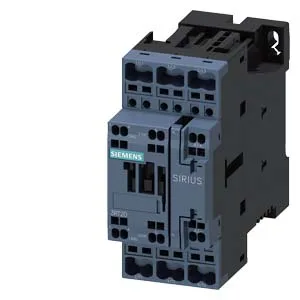
The coil holds at 24 VDC nominal with an operating range of 0.8 to 1.1 times rated value. Below that dropout threshold, the contactor releases cleanly. Switching frequency depends on duty: 1 000 cycles/hour max for AC-1 resistive loads, 750 cycles/hour for AC-2 and AC-3 motor starting, 250 cycles/hour for AC-4 plugging/reversing, and 750 cycles/hour for AC-3e. Match your load profile to the right column — AC-4 at 250 ops/h is the limiter for frequent jogging or inching.
That's tight enough for dense panel layouts but leaves enough air for arc quenching. Wire sizes: solid or stranded 1 to 10 mm² for main power connections, and 2x (0.5 to 2.5 mm²) for auxiliary circuits. The spring-type terminals on the coil side hold firm without re-torquing — set it and forget it.
Electrical life depends on load and switching frequency, but the mechanical endurance gives you headroom for high-cycle conveyor or pump starts.
No IP rating listed in the evidence, so treat it as open-frame — mount inside a sealed enclosure if washdown or dust is present. The auxiliary switch is included (yes), so you get a built-in N/O or N/C contact for status feedback or interlocking without adding a separate block. Arcing time is 10 to 10 ms — consistent, repeatable quenching across the load range.