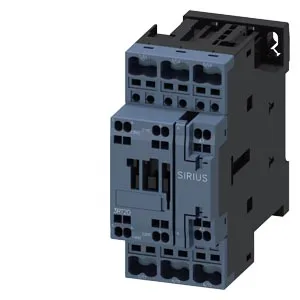
It is fitted with a 24 VDC magnet coil terminated via spring-type terminals, which eliminates the need for periodic screw retorquing in high-vibration environments. The contactor includes an integrated auxiliary switch, providing a separate set of contacts for status feedback or interlocking without requiring a separate add-on block.
This rating is the current-carrying capacity for the auxiliary circuit, not the main power path — it governs the size of the load the auxiliary contacts can switch, such as a PLC input or a pilot light. Switching frequency is rated at 1,000 cycles per hour under AC-1 (resistive) load, 750 cycles per hour under AC-3 (motor) load, and 250 cycles per hour under AC-4 (inching/plugging) duty. The coil hold-in voltage is specified at 24 V rated value, with a drop-out threshold that typically falls below 18 V. The spring-type terminals on the coil accept solid or stranded wire from 1 to 10 mm², and also accept two conductors of 0.5 to 2.5 mm² each for daisy-chaining control wiring. Electrical life will be lower and depends on the switched load and duty cycle.
The storage range is wider because the contactor is not switching current during storage — the limit that matters for installation is the operating range.