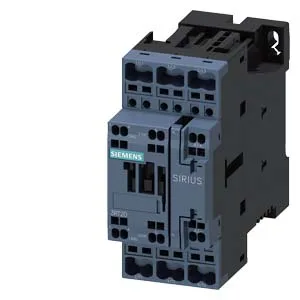
It carries a 24 VDC coil and uses spring-type terminals for the main and auxiliary circuits, so there is no screw-torque check on a fast swap — strip, push, done. It mounts via screw or snap-on onto 35 mm DIN rail per DIN EN 60715, and the mounting position allows ±180° rotation on a vertical surface plus ±22.5° tilt forward and backward. That flexibility helps when you are squeezing it into a tight gland plate layout.
The 24 VDC coil pulls 10 A at its rated voltage, so size your control transformer and fuse accordingly — that is a healthy inrush for a DC coil, and the hold-in current will be lower, but the pick-up surge is what dictates the power supply. Switching frequency limits are given per duty class: 1 000 operations/hour at AC-1 (resistive loads), 750 at AC-2 and AC-3 (motor starting and running), and 250 at AC-4 (plugging and inching). If your application cycles a motor on and off more than 750 times an hour, this contactor will overheat — step up to a larger frame or a dedicated switching device. That -25 °C lower bound matters for unheated enclosures in northern climates — the coil must pull in reliably at cold start. Spring-type terminals accept 1 to 10 mm² solid or stranded, or 2x (0.5 to 2.5 mm²) with ferrules.