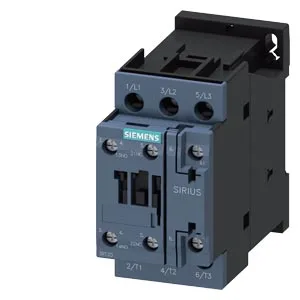
The contactor carries an auxiliary switch and the magnet coil termination is screw-type terminals, so wiring is straightforward with a standard screwdriver — no special crimp tool needed for the coil circuit.
At 480 V rated value the contactor is rated 34 A — that is the current it can switch in the specified duty class (likely AC-3 motor duty, though the exact duty class for that 34 A figure is not broken out in the available data). For auxiliary contact switching at 24 V it handles 10 A, dropping to 0.3 A at 220 V and 0.6 A at 440 V. These auxiliary ratings govern what you can drive directly from the contactor's own auxiliary contacts — a PLC input or a small relay coil at 24 V is fine; a 220 V indicator lamp needs to stay under 0.3 A. Switching frequency varies by duty: AC-1 (resistive) allows up to 1 000 operations per hour, AC-2 and AC-3 (motor) allow 750 per hour, and AC-4 (plugging/inching) is limited to 250 per hour. If your application cycles a motor more than 12 times a minute under full load, the AC-4 limit is the one to watch. The storage limit governs handling during shipping and warehouse idle — not a running condition.
Dimensions: 97 mm depth, 45 mm width, 85 mm height. These are the minimum air gaps to adjacent components for heat dissipation and arc flash clearance — respect them in your panel layout. Wire range: solid or stranded 1 to 10 mm², with two-wire capability for 2x (0.5 to 1.5 mm²) and 2x (0.75 to 2.5 mm²). That covers most control-circuit wiring up to 10 mm² for the main power path.