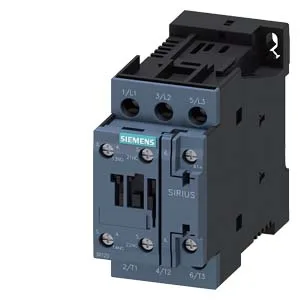
DC auxiliary contact ratings — the number that matters for PLC interfaces
The built-in auxiliary switch is rated for DC loads at several voltage points: 10 A at 24 V, 2 A at 48 V and 60 V, 1 A at 110 V, 0.9 A at 125 V, and 0.3 A at 220 V. These numbers govern whether the contactor can directly switch a PLC input or relay coil without an interposing relay. At 24 V the full 10 A covers most solenoid loads; above 48 V the current drops sharply due to DC arc extinction limits — plan for that drop if driving a 125 VDC valve bank.
Switching frequency by duty class
Maximum switching rates are specified per IEC duty class: 1 000 cycles/hour at AC-1 (resistive), 750 cycles/hour at AC-2 and AC-3 (slip-ring and squirrel-cage motors), and 250 cycles/hour at AC-4 (plugging/inching). The AC-3e rating also allows 750 cycles/hour. For a conveyor line running AC-3 duty at 750 cycles/hour, the contactor can cycle every 4.8 seconds — adequate for moderate-speed start/stop profiles but not for high-speed indexing where you'd need a larger frame or a contactor with a higher mechanical life.
Those spacings are required for heat dissipation and arc flash containment — crowding the contactor against other devices will shorten coil life. The screw-type terminals accept solid or stranded wire from 1 to 10 mm², and two conductors per terminal from 0.5 to 2.5 mm².