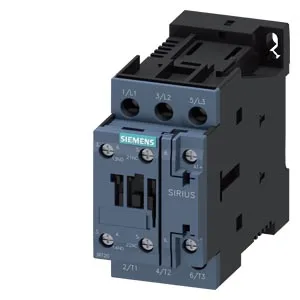
The Siemens 3RT2028-1XF40-0LA2 is a size S0 contactor from the SIRIUS family, with a 110 VDC coil terminated via screw-type terminals. It snaps onto 35 mm DIN rail per DIN EN 60715, and the mounting position allows +/-180° rotation on a vertical surface plus +/-22.5° tilt forward and backward. The DC coil means you are switching a solenoid that pulls in at 70% of rated voltage and drops out at 125% — the pickup factor is 0.7 and the dropout factor is 1.25, so on a 110 VDC bus it picks up at 77 V and drops out when the voltage rises to 137.5 V. That dropout behavior matters if you are using the contactor in a DC control loop with a weak supply; the coil will hold in until the bus climbs, not sag.
The main contacts accept solid conductors from 1 to 10 mm² in a dual-entry configuration — 2x (1... 2.5 mm²) and 2x (2.5... 10 mm²). The auxiliary contacts handle 2x (0.5... 1.5 mm²) solid or stranded and 2x (0.75... 2.5 mm²). For a panel builder, that means you can land a 6 AWG feed on the main terminals without a ferrule, and the auxiliary side takes standard 14 AWG control wiring. The contactor is rated for 750 switching cycles per hour under AC-1, AC-2, AC-3, and AC-3e duty, and 250 cycles per hour under AC-4. That 750/h ceiling on AC-3 is the practical limit for motor starting applications — a pump cycling every 4.8 seconds is within spec, but jogging a motor at higher rates will exceed the AC-4 rating.
Mechanical service life is typical 10,000,000 operations — the contactor will outlast most machines it controls if the electrical load stays within the AC-3 curve. In a crowded DIN-rail cabinet, that side gap is the tightest constraint — you can pack contactors with 6 mm between them, but the vertical clearance needs a full 10 mm for arc dissipation. Arcing time is 10 ms, so the arc chute clears fast enough for most coordination studies.
Physical footprint
Width at 45 mm is standard for a size S0 contactor, matching the footprint of the 3RT2028-1BB40 and 3RT2027-1AF00 siblings.