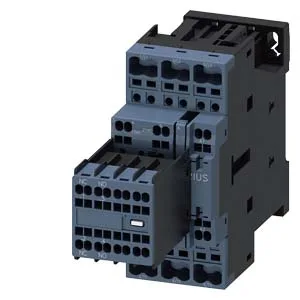
SIRIUS power contactor, Size S0 — 34 A at 480 V AC-3
The Siemens 3RT2028-2AV04 is a SIRIUS power contactor in the Size S0 frame, rated for 34 A at 480 V in AC-3 duty — the standard motor-switching category per IEC 60947-4-1. That 34 A figure governs the maximum full-load current of a three-phase induction motor it can switch under normal starting and running conditions; for a 480 V supply, that typically covers motors up to about 25 hp, though the exact horsepower depends on the motor's full-load amps and service factor. The contactor carries a 5 hp rating at 230 V, confirming its suitability for smaller motors on lower voltages as well. Spring-type terminals on the magnet coil and main contact wiring rated for solid or stranded conductors from 1 to 10 mm², with auxiliary contacts accepting 2x (0.5 to 2.5 mm²). The contactor mounts via screw and snap-on onto 35 mm DIN rail per DIN EN 60715, and the mounting position allows ±180° rotation on a vertical surface plus ±22.5° tilt forward/backward — useful when panel layout forces an unconventional orientation.
Switching frequency and duty-cycle limits
The contactor's maximum switching frequency depends on the utilization category: 1,000 operations per hour in AC-1 (resistive loads), 750 per hour in AC-2 and AC-3 (motor starting and running), and 250 per hour in AC-4 (plugging or inching duty) (–,). AC-4 is the most severe — each operation involves making and breaking locked-rotor current — so the lower limit reflects the thermal stress on the contacts. For a motor circuit running at AC-3, the 750 ops/h ceiling is rarely a constraint in normal process control; it becomes relevant only in high-cycle applications like indexing conveyors or rapid reversing.
DC switching ratings and auxiliary contact configuration
The contactor carries DC switching ratings across a range of voltages: 6 A at 24 V, 2 A at 48 V and 60 V, 1 A at 110 V, 0.9 A at 125 V, 0.3 A at 220 V, and 3 A at 400 V (–,). These are the maximum currents the main contacts can break in a DC circuit at the stated voltage — DC arcs are harder to extinguish than AC, so the ratings drop sharply as voltage rises. The auxiliary contact block is not factory-fitted (shows 18 to 8 auxiliary contacts, likely a range for field-installable add-on blocks; the base unit ships without auxiliary switches. Plan to order a separate auxiliary contact block if the application needs feedback or interlocking.
Environmental limits and mechanical endurance
Dimensions: 102 mm height, 45 mm width, 144 mm depth.