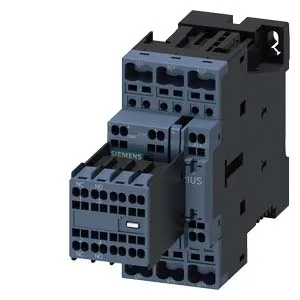
The 45 mm width and 102 mm height leave room for adjacent devices in a crowded rail.
The main contacts are rated for 18 to 8 A, but the real selection driver is the duty-specific switching frequency. At AC-3 (squirrel-cage motor starting), the contactor handles up to 750 operations per hour; at AC-4 (plugging/reversing), that drops to 250 ops/h. For resistive loads (AC-1), it can cycle at 1,000 ops/h. These limits govern thermal rise in the enclosure — pushing past them accelerates contact wear. The 24 VDC coil draws 6 A at rated value, with a dropout time of 15 to 18 ms. Switching capacity on the coil side is specified across voltages: 2 A at 48 VDC, 1 A at 110 VDC, 0.3 A at 220 VDC, and 3 A at 400 VAC. The 1.1 full-scale factor and 0.8 initial value bracket the coil's operating range under varying supply conditions. Spring-type terminals accept solid or stranded wire from 1 to 10 mm², with dual-wire capability for 2x (0.5 to 2.5 mm²). This eliminates the need for ferrules on stranded conductors and speeds panel wiring.