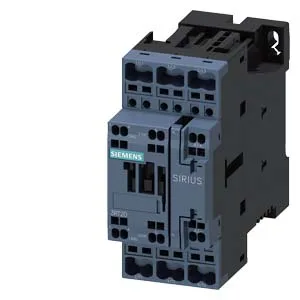
It carries a 110 V AC coil and spring-type terminals on both power and auxiliary circuits — no screw torque to check, which saves time on a panel build or a quick swap-out on the route.
The main contacts are rated for AC-3 motor duty — that's the standard for squirrel-cage motors during starting and switching off under load. At 230 V, this contactor handles motor loads up to 5 hp, which covers a lot of common pump, fan, and conveyor motors on the plant floor. DC switching ratings are provided for several voltages: 10 A at 24 V, 2 A at 48 V and 60 V, 1 A at 110 V, 0.9 A at 125 V, 0.3 A at 220 V, and 3 A at 400 V. These matter if you're breaking DC loads like brake coils or DC bus circuits — the arc extinguishes differently than AC, so the contactor is specifically rated for it. The coil pickup is rated at 110 V with an operating range of 0.8 to 1.1 times rated value — so it pulls in reliably between 88 V and 121 V. Dropout and arcing times are in the 10–18 ms range, which is typical for this contactor class and fast enough for most control schemes. Switching frequency limits vary by duty: up to 1,000 operations per hour for AC-1 (resistive), 750/h for AC-2 and AC-3 (motor starting/stopping), and 250/h for AC-4 (plugging, inching, reversing). If you're running a high-cycle application like a rapid-indexing conveyor, stay within the AC-4 ceiling to avoid contact welding.
Wiring and Panel Integration
Strip length and ferrule sizing follow the usual spring-clamp practice — no special tools beyond a screwdriver to press the release. The 45 mm width and 102 mm height fit the standard S0 footprint; depth is 107 mm including the arc chamber. That's the minimum air gap to adjacent metalwork or other devices for safe operation at rated voltage. Keep those gaps in the panel layout, especially when mounting multiple contactors side-by-side.