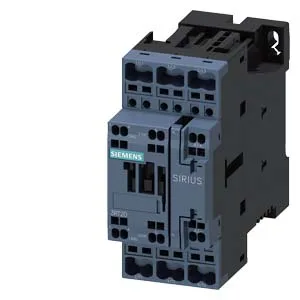
The 3RT2028-2FB40: The 24 VDC coil pulls 10 A at rated voltage, and the contactor carries a 5 hp rating at 230 V for motor duty. Spring-cage terminals on both coil and main contacts accept 1 to 10 mm² solid or stranded wire, with dual-wire capacity up to 2x 2.5 mm² on the auxiliary contacts.
The 45 mm width and 107 mm depth mean it occupies a single DIN module — plan your gland-plate fill and wireway clearance accordingly. That's tight enough for dense rail packing, but respect the 10 mm forward gap for arc flash and cooling — don't bury it against a gland plate.
Switching duty and life
Rated operating cycles per hour vary by duty: 1,000/h at AC-1 (resistive), 750/h at AC-2 and AC-3 (motor starting/running), and 250/h at AC-4 (plugging, inching). The AC-3e rating also sits at 750/h. DC switching ratings are provided: 10 A at 24 V, 2 A at 48 V, 2 A at 60 V, 1 A at 110 V, 0.9 A at 125 V, 0.3 A at 220 V, and 3 A at 400 V. If you're switching DC motor brakes or solenoid valves, size against the applicable voltage row.
Environment and auxiliary contacts
Coil pickup and dropout: arcing time is 10 ms; DC dropout is 15–18 ms. Initial pull-in value is 0.8 x rated voltage, so it holds in through dips down to about 19.2 VDC on a 24 V system — useful on lines with weak DC supplies or long cable runs.