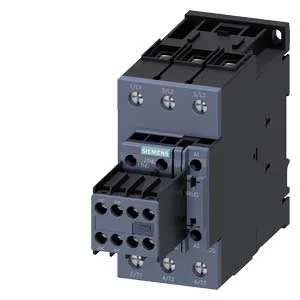
The Siemens 3RT2035-1AG24 is a SIRIUS S2 power contactor — a three-pole, 24 VDC-coil unit rated at 6 A at 24 V. The S2 frame size keeps the footprint compact at 55 mm wide, 114 mm tall, and 174 mm deep, so it slots into crowded enclosures without re-spacing.
That's a standard response for a contactor this size — fast enough for motor starting, not so fast that it causes nuisance tripping on inrush. The coil terminals are screw-type, accepting 2x (0.5–1.5 mm²) or 2x (0.75–2.5 mm²) solid or stranded wire.
Duty ratings and mechanical life
The contactor is rated for different switching frequencies depending on duty class: 1,200 operations per hour at AC-1 (resistive loads), 750 at AC-2 (slip-ring motors), 1,000 at AC-3 (squirrel-cage motors), and 300 at AC-4 (plugging/inching). The AC-3e rating also sits at 1,000 ops/h. Mechanical life is listed at 10 million operations typical — that's a long service life for a panel that cycles infrequently, but if you're running near the max AC-3 rate, you'll hit that number in about 11,000 hours of continuous use.